|
First Tertiary General Hospital in Seoul to Introduce AI Monitoring System ‘thynC’ for All Beds
|
|
- Completing a 24-hour real-time vital sign management system for inpatients - AI-based detection of abnormal signs and HIS integration to strengthen patient safety and medical staff work efficiency - President Lee Hyeongjoong: “A turning point in realizing a smart hospital based on digital health care”
Hanyang University Hospital (President Lee Hyeongjoong) became the first tertiary general hospital in Seoul to introduce the artificial intelligence (AI)-based bed monitoring system ‘thynC’ for all beds, accelerating the development of a smart hospital based on digital health care.
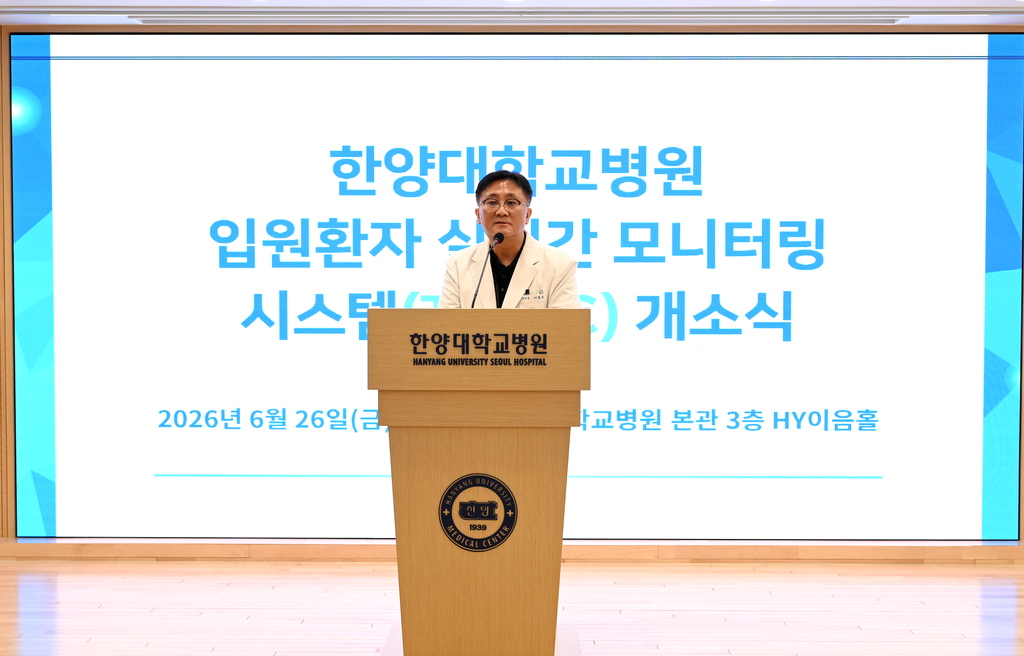
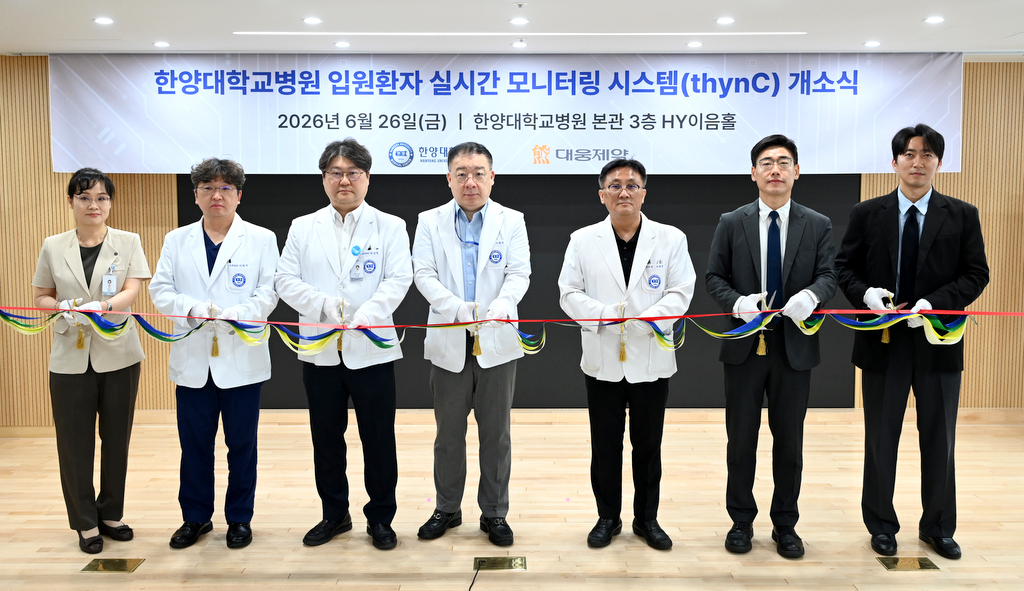
In cooperation with Daewoong Pharmaceutical, Hanyang University Hospital recently completed the installation of the AI-based patient monitoring system in all general beds except special beds, and held the ‘Opening Ceremony for thynC Introduction in All Beds’ at HY Ieum Hall on the 3rd floor of the Main Building on June 26. Key officials and many faculty and staff attended the event and shared the system’s operating status.
Whereas medical staff previously measured and recorded patients’ conditions at regular intervals, the new system introduces a constant monitoring system that allows inpatients’ vital signs to be checked in real time 24 hours a day, creating an environment in which changes in patient condition can be continuously detected and abnormal signs identified early. This is especially significant in that it strengthens patient safety and rapid response systems, given the nature of tertiary general hospitals with a high proportion of severe patients.
‘thynC’ is an AI-based smart monitoring system that non-invasively measures key vital signs such as electrocardiogram, heart rate, respiratory rate and oxygen saturation using wearable sensors. The collected data are analyzed by AI in real time, and when abnormal signs occur, an alarm is immediately sent to medical staff to support a rapid response.
In particular, integration with the hospital information system (HIS) allows patient data to be automatically recorded and analyzed, greatly reducing the burden of manual data entry for medical staff. As a result, medical staff can focus more on patient care and clinical judgment than on repetitive administrative work.
Taking the introduction of this system as an opportunity, Hanyang University Hospital plans to further advance its data-based patient management system and accelerate the establishment of an AI prediction-based medical environment. Furthermore, it intends to actively use digital health care technology to continuously expand patient-centered smart medical services.
President Lee Hyeongjoong said, “The introduction of thynC is a key task of our smart hospital strategy for strengthening patient safety,” adding, “We will continue to actively introduce advanced digital medical technologies to provide safer, higher-quality patient-centered medical services.”
Daewoong Pharmaceutical CEO Lee Changjae said, “The case of Hanyang University Hospital is a milestone showing that an AI monitoring system can simultaneously enhance patient safety and medical efficiency at a tertiary general hospital,” adding, “Daewoong Pharmaceutical will continue to expand the scope of thynC’s application through cooperation with various medical institutions and continue to grow its digital health care business” (End). |
News
Hanyang University International Hospital