|
Professor Bae Sangcheol’s Team Identifies Genetic Variants Causing Lupus
|
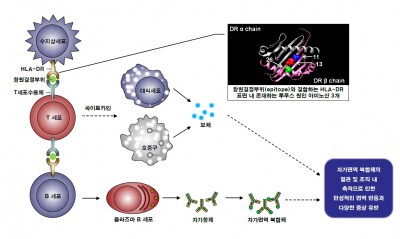
Professor Bae Sangcheol’s team at Hanyang University Hospital for Rheumatic Diseases develops ‘lupus prediction model using HLA gene variants’HLA gene variants identified through genetic epidemiological analysis of 5,850 people, published in Nature CommunicationsSpecific genetic variants that cause the onset of ‘systemic lupus erythematosus (hereinafter lupus)’ have been identified for the first time, and a ‘lupus prediction model’ applicable not only to Koreans but also to other ethnic groups has been developed, opening the way to predicting lupus more accurately. Lupus is a rheumatic autoimmune disease caused by a combination of environmental factors and multiple genetic variants, and while HLA genes had been known to be associated with the onset of lupus, exactly which genetic variants have an effect had not been identified. To identify the causal genetic variants of lupus within the HLA genes, Professor Bae’s team precisely analyzed the HLA gene variants of 950 Korean lupus patients and 4,900 controls. The genetic variants used in the analysis included not only previously studied single nucleotide polymorphisms (SNPs) but also the genotypes and amino acid sequence variants of eight HLA genes (HLA-A, -B, -C, -DQA1, -DQB1, -DRB1, -DPA1, -DPB1). In particular, this study incorporated the ‘Korean HLA reference panel,’ recently published by Professor Bae’s team, which can accurately predict HLA genotypes and amino acid sequences, and used various statistical techniques. As a result, Professor Bae’s team revealed the new finding that amino acid variants at positions 11, 13 and 26 within the HLA-DRB1 gene are associated with the onset of lupus. The team additionally found that HLA-DRB1*15:01 and HLA-DRB1*03:01, previously known as important genetic variants in lupus onset, were simply derived from the three amino acid variants identified in this study. The team also demonstrated that the new ‘lupus prediction model’ developed using this amino acid combination is a highly reliable model applicable not only to Koreans but also to other Asians and white populations. In this regard, Professor Bae said, “HLA genes and the surrounding DNA bases are the most variable and structurally complex in the human genome, so it had not been easy to identify genetic variants associated with the onset of lupus, but with the identification of three amino acid variants that directly affect the function of HLA-DR, a broader understanding of the mechanism of lupus onset has become possible, and ultimately more accurate prediction of onset will become possible, making a great contribution to the development of predictive medicine for lupus.” This study was conducted with support from the Health and Medical Research and Development Program (Researcher-Driven Convergence-Based Research – Basic Technology for Clinical Application of Genomics) (End). [Reference 1] What is systemic lupus erythematosus? Systemic lupus erythematosus is one of the representative rheumatic diseases that occur mainly in women; although its exact cause is not well known, it is known to be an autoimmune disease that occurs when abnormalities develop in the immune system due to the combined action of genetic, environmental and hormonal factors. Although it is a similar autoimmune disease, whereas the main target of attack in rheumatoid arthritis is the joints, lupus can attack virtually any part of the body, so it presents far more diverse symptoms. It is one of the most difficult diseases to treat, often referred to as a disease with ‘a thousand faces.’ The name ‘lupus’ comes from the Latin word meaning ‘wolf,’ given because the skin turns red as if bitten by a wolf. [Reference 2] What is HLA? HLA (human leukocyte antigen, histocompatibility antigen) is a protein that binds to the initial epitope (epitope), one of the most important factors in the process from recognition of autoantigens to the production of autoantibodies in lupus, and plays a pivotal role in inducing immune responses against autoantigens. HLA proteins present on the surface of antigen-presenting cells interact with T cells to simultaneously induce innate and adaptive immune responses. Lupus is a chronic disease in which autoantibodies against autoantigens are produced, and the resulting autoantibody-antigen complexes accumulate in blood vessels and organs, causing various inflammatory responses throughout the body. The three newly discovered HLA-DRB1 amino acid positions make up the HLA-DR protein and, in particular, are located on the surface that binds directly to the epitope (epitope), showing that these amino acids interact directly in the immune response caused by autoantigens. [Figure 1] |
News
Hanyang University International Hospital