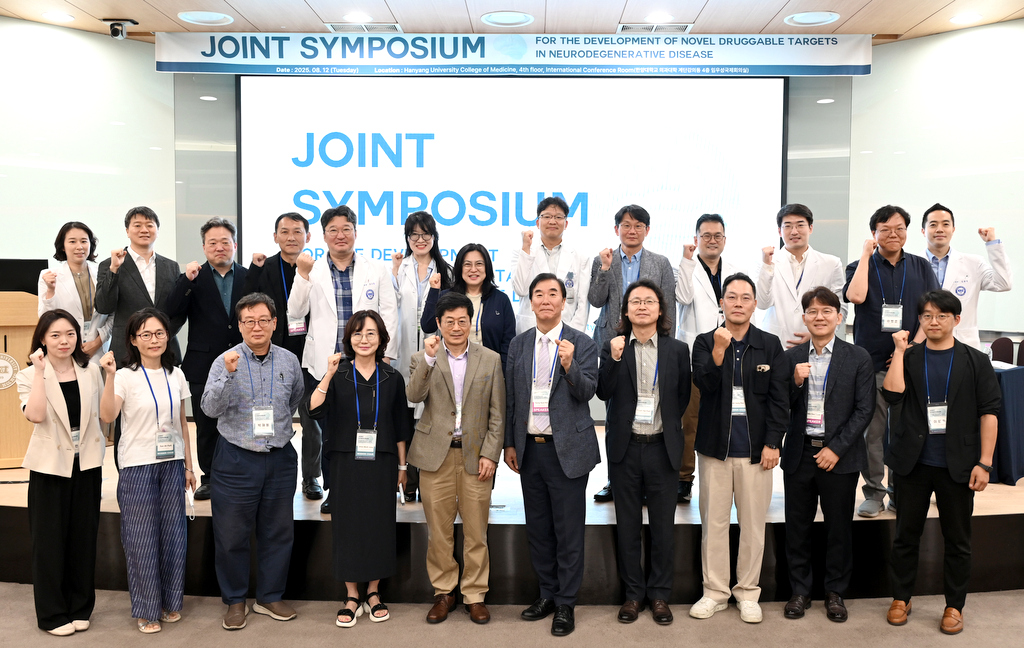
Sharing the latest research results and cooperation strategies for overcoming dementia globally and developing new drugs
The Cell Therapy Center of Hanyang University Hospital (Director Kim Seunghyun) held the ‘Joint Symposium for the Development of Novel Druggable Targets in Neurodegenerative Disease’ at the Lim Woosung International Conference Room on the 4th floor of the tiered lecture building of Hanyang University College of Medicine on August 12.
The symposium was arranged as part of global dementia prevention and treatment technology development research under the Ministry of Health and Welfare’s Dementia Research and Development Project, and served as a forum for academic exchange to share the discovery of new targets and precision medicine approaches in treatment strategies for neurodegenerative diseases and to discuss the latest research trends.
The event began with an opening address by Professor Kim Seunghyun of the Department of Neurology, principal investigator of the global dementia project and Director of the Cell Therapy Center at Hanyang University Hospital, and proceeded in two sessions: ▲Session 1: 'Development of a Global Platform for Customized Treatment Strategies Based on Novel Drug Targets for Alzheimer’s Disease' and ▲Session 2: 'Treatment Strategies Using Protein Aggregation Dynamics, Immunity and Blood-Based Biomarkers in Neurodegenerative Diseases.'
In Session 1, presentations were given on ▲ApoE and Brain Lipid Metabolism in Aging and Alzheimer’s Disease (Professor Guojun Bu, Hong Kong University of Science and Technology) ▲miRNA-214 as a Novel Biomarker Predicting Rapid Clinical Progression in Neurodegenerative Diseases (Professor Kim Seunghyun, Hanyang University Hospital) ▲Acetylation of Cox-2 and Regulation of Microglia and Alzheimer’s Disease (Professor Jin Heekyung, Kyungpook National University, and Dr. Kim Kyungyeol) ▲Association between ApoM-Bound S1P and APOE in Alzheimer’s Disease (Dr. Choi Byungjo, Kyungpook National University) ▲Inhibition of miRNA-214-3p Using Tough Decoy and Discovery of a Novel AAV Capsid for Alzheimer’s Disease (Vice President Kim Jongwan and researcher Lee Bumhwi, GenixCure).
In Session 2, presentations were given on ▲Targeting Stress Granule Dynamics in Amyotrophic Lateral Sclerosis (Senior Researcher Nam Minyeob, Korea Brain Research Institute) ▲Aged Microglia: A Universal Therapeutic Target Beyond Subtypes (Professor Kwon Minsoo, CHA University) ▲Synthesis of RNA Nanoplatforms for Efficient RNA-Based Gene Regulation (Professor Lee Jongbum, University of Seoul) ▲Blood Biomarkers for Alzheimer’s Disease (Professor Ko Sungho, Hanyang University Guri Hospital) ▲Differences in Sex Phenotypes of Amyotrophic Lateral Sclerosis and Brain-Body Connection Mechanisms (Professor Minh Dang Nguyen, University of Calgary).
In particular, Professor Guojun Bu (Hong Kong University of Science and Technology), an advisor to the global dementia network and a world authority on APOE4 genotype research, participated to share the latest research results and presented future directions and cooperation strategies for global joint research through in-depth discussions.
The sessions were chaired by ▲Part 1: Mook Inhee, Director (Seoul National University, Korea Dementia Research Center (KDRC)), and Professor Bae Jaesung (Kyungpook National University) ▲Part 2: Professor Park Hwantae (Dong-A University, President of the Korean Society for Neurodegenerative Disease) and Professor Park Suna (Ajou University, President-elect of the Korean Society for Neurodegenerative Disease), who led in-depth discussions on strategies for experts from academia and industry to cooperate to increase the possibility of clinical application. Director Mook Inhee, one of the chairs, said, “For the effective prevention and treatment of neurodegenerative brain diseases such as dementia, we will actively pursue research support and the strengthening of international networks so that global-level cooperation and target-centered research can lead to the development of practical treatments.”
Kim Seunghyun, Director of the Cell Therapy Center, said, “This symposium was arranged to strengthen the global cooperation network for neurodegenerative brain disease research and to discuss the discovery of innovative targets and strategies for new drug development,” adding, “I hope that research increasing the possibility of future clinical application will continue through exchanges between academia and industry.” (End)

