|
‘Dysphagia’ in Parkinson’s Disease Found to Be Caused by Dopamine Changes in the Striatum
|
Professor Kim Joonyeob publishes in international journal “Clinical Nuclear Medicine”
These results, from joint research by Professor Kim Joonyeob of the Department of Physical Medicine & Rehabilitation at Hanyang University Hospital and the Veterans Medical Research Institute and the Departments of Rehabilitation Medicine, Neurology and Nuclear Medicine of VHS Medical Center, were revealed in a paper titled “Striatal Dopaminergic Loss and Dysphagia in Parkinson Disease” in the latest issue of the international journal
Gastrointestinal disorders are common symptoms in patients with Parkinson’s disease, and among them, dysphagia can cause malnutrition and aspiration pneumonia, contributing to increased mortality; depending on the report, up to about 90% of patients with Parkinson’s disease are known to eventually develop dysphagia. Previously, several studies had been conducted on brain activation during swallowing in healthy people or on structural brain changes related to dysphagia in stroke patients, but there had been almost no research on the relationship between the striatal distribution of neurotransmitters in patients with Parkinson’s disease and dysphagia.
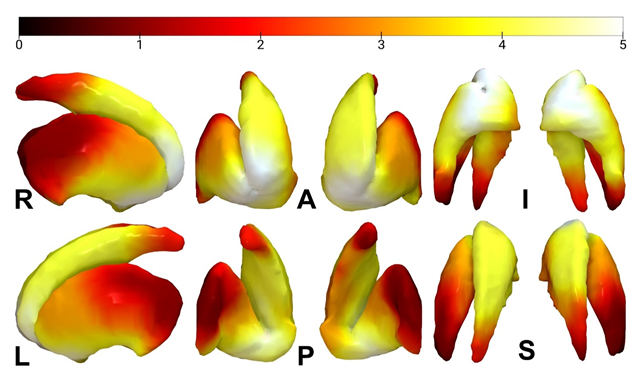
Professor Kim Joonyeob studied 65 patients who met the study’s selection criteria among 581 patients diagnosed with Parkinson’s disease at VHS Medical Center from 2015 to 2021, evaluating impairments in each stage of swallowing food, such as chewing function, transit time and residue, through 14 sub-items in the oral and pharyngeal phases, the two main stages of swallowing. Differences in the degree of striatal neuron degeneration according to impairment in each stage were calculated from dopamine transporter uptake obtained through positron emission tomography (PET) scans. This study revealed for the first time clear differences in the distribution of reduced striatal dopamine transporter availability by stage of dysphagia in Parkinson’s disease (figure).
Figure. Striatal distribution of reduced dopamine transporter uptake according to the number of dysphagia sub-items judged abnormal. The association between dysphagia and each striatal region is shown from red (overlap of the fewest sub-items) to white (overlap of the most sub-items). R: right side, L: left side, A: anterior side, P: posterior side, I: inferior side, S: superior side.
Professor Kim said, “The pleasure of eating delicious food by mouth is a great joy and a basic desire for most people, but when a disease makes it impossible to chew and swallow food by mouth, it seriously reduces quality of life and even becomes a major obstacle to prolonging life,” adding, “Research on dysphagia is very important in that it is research that enables people to live as human beings, and I will continue to do my utmost to study the neurological pathophysiology of dysphagia in various diseases and to develop treatments accordingly.”
Professor Kim Joonyeob completed his undergraduate studies at Yonsei University College of Medicine and received his master’s degree from the same graduate school, and he currently combines clinical practice and research at the Department of Physical Medicine & Rehabilitation at Hanyang University Hospital, specializing in rehabilitation for degenerative brain diseases including brain injury, ALS, Parkinson’s disease and movement disorders, as well as dysphagia rehabilitation.
* Striatum: A region forming the basal ganglia deep in the cerebrum that mediates functions such as reward, cognition, reinforcement, motivation, movement, inhibitory control, impulsivity and stimulus-response cognition. Degeneration of dopaminergic neurons in this region is closely related to movement disorders such as Parkinson’s disease and Huntington’s disease. It is a central nervous system structure that is also associated with substance dependence, bipolar disorder, autism spectrum disorder and more.
|
News
Hanyang University International Hospital
 A study has found that the cause of dysphagia, known as a major factor in increased mortality and reduced quality of life in patients with Parkinson’s disease, is associated with the degeneration of dopaminergic neurons in the *striatum, which plays an important role in initiating and controlling voluntary movement in the brain. Based on these results, striatal dopamine transporter uptake in Parkinson’s disease can be used as a biological marker to predict the occurrence of dysphagia and the severity of its symptoms, and it may provide a clue to finding the anatomical location for neuromodulation treatment specific to dysphagia symptoms.