|
Only 40% Visit a Hospital After Diagnosis of ‘Nonalcoholic Fatty Liver Disease,’ Which Has a High Cardiovascular and Cerebrovascular Mortality Rate
|
Hanyang University Hospital and Nowon Eulji University Hospital research team, online survey of 1,000 members of the general public“Need for effective, systematic lifestyle modification education by medical staff”
Nonalcoholic fatty liver disease refers to a condition in which there is fatty liver without other causes such as significant alcohol consumption, drugs or viral hepatitis. The prevalence of nonalcoholic fatty liver disease among Koreans is known to be 25–30%, and patients with nonalcoholic fatty liver disease are characterized not only by a high risk of chronic hepatitis, cirrhosis and liver cancer but also by a high risk of cardiovascular and cerebrovascular disease.
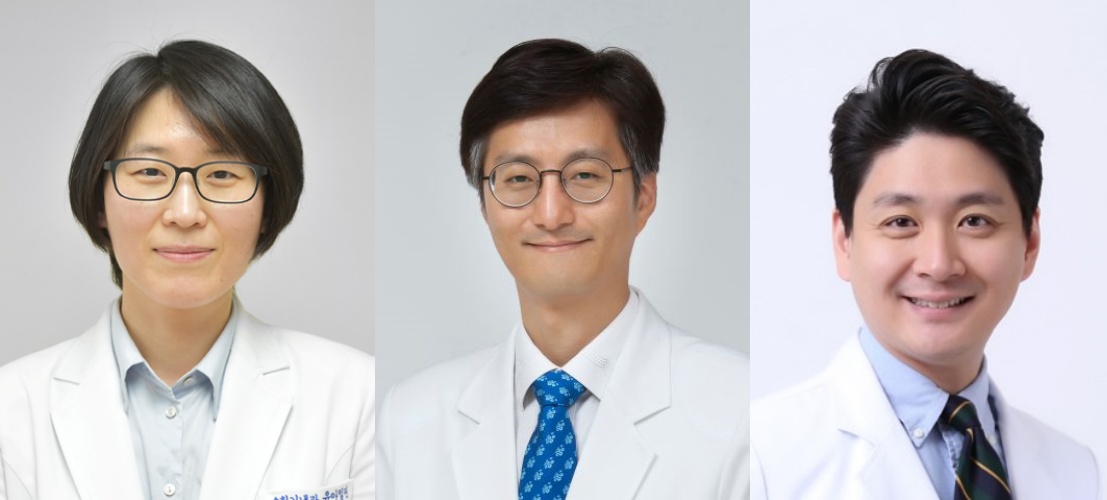
The team of Professors Yoon Ailin and Jun Daewon (principal investigator) of the Department of Gastroenterology at Hanyang University Hospital and Professor Lee Joonhyuk of the Department of Family Medicine at Nowon Eulji University Hospital announced these results from a large-scale online survey of 1,000 members of the general public on ‘Awareness and Needs Regarding Nonalcoholic Fatty Liver Disease,’ conducted with support from an academic research service project of the Korea National Institute of Health under the Korea Disease Control and Prevention Agency (KDCA).
Professor Yoon Ailin of the Department of Gastroenterology at Hanyang University Hospital said, “For nonalcoholic fatty liver disease, in which one in three patients is known to die from cardiovascular or cerebrovascular disease, the most recommended measure is lifestyle modification,” adding, “Along with this, having an accurate awareness of nonalcoholic fatty liver disease is necessary for successful lifestyle modification.”
The survey was commissioned by Hanyang University Hospital to the survey agency Macromill Embrain Co., Ltd. and conducted from September 7 to 14, 2022, with a gender ratio of 51% men and 49% women, and was designed according to regional and age distribution in Korea. The sampling error is ±3.1 percentage points at the 95% confidence level. As a result, the following key findings related to nonalcoholic fatty liver disease were obtained.
Awareness of fatty liver disease among the Korean general public is relatively high
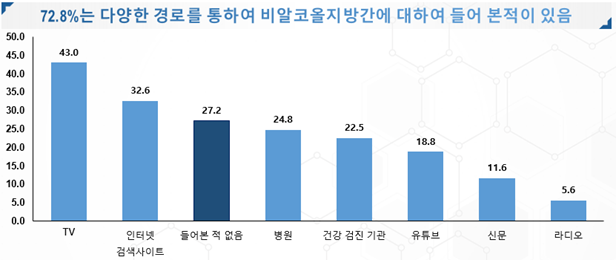
Of the survey respondents, 72.8% said they had heard of nonalcoholic fatty liver disease through various channels (Figure 1). Of the respondents, 85.7% were aware that fatty liver can develop even without drinking alcohol, and 82.5% recognized nonalcoholic fatty liver as a disease requiring treatment.
Figure 1. Channels of awareness of the term nonalcoholic fatty liver disease
Only 40% of those diagnosed with nonalcoholic fatty liver visit a medical institution
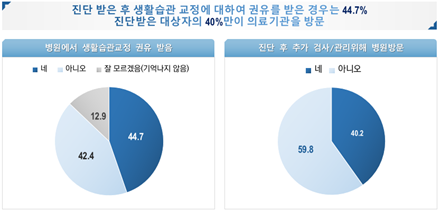
Of the respondents, 13.2% said they had been diagnosed with nonalcoholic fatty liver disease. Only 40.2% of those diagnosed with nonalcoholic fatty liver visited a medical institution to manage it. Reasons for not visiting a medical institution differed somewhat between men and women. The most common response among men was ‘because I lack time to visit the hospital,’ and among women ‘because I think I can manage my lifestyle on my own.’ By age group, those in their 40s and younger said they did not visit the hospital ‘because I lack time to visit the hospital,’ those in their 50s ‘because I think I can manage my lifestyle on my own,’ and those in their 60s and older ‘because I don't think fatty liver itself is a serious disease,’ suggesting a need for individualized awareness improvement by gender and age group.
Only 44.7% had received lifestyle recommendations when diagnosed with fatty liver. Among those advised by medical staff to modify their lifestyle, 59.3% visited a hospital, while among those not advised, 24.7% visited a hospital, identifying advice from medical staff as a key factor in deciding to seek hospital care. Of the respondents, 32.9% answered that their reason for not visiting a hospital for care after diagnosis of nonalcoholic fatty liver was ‘because I was not told by medical staff that I needed management’ (Figure 2).
Figure 2. Medical institution visits after diagnosis of nonalcoholic fatty liver
Need for diet and exercise education programs for nonalcoholic fatty liver
As the lifestyle modification for the prevention and management of nonalcoholic fatty liver disease, men ranked ‘increasing exercise’ first and women ranked ‘weight loss’ first. By age group, those in their 20s, 50s and 60s ranked ‘increasing exercise’ first, and those in their 30s and 40s ranked ‘weight loss’ first.
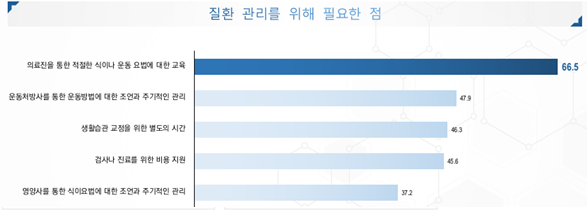
Of the respondents, 66.5% said that education on appropriate diet or exercise therapy through medical staff is needed to manage fatty liver. In particular, the proportion was higher among women and those in their 40s and older, confirming the general public's desire for the management of nonalcoholic fatty liver disease to be run systematically through medical staff. In addition, the demand for management through mobile phone applications, easily accessible according to each individual's time and availability, was also high at 60.2%, and the demand for such mobile app-based management was higher among older people and those living in metropolitan cities or small and medium-sized cities. Management through visits to public health centers was desired by 47.3%, with higher demand among older people.
Figure 3. What is needed to manage nonalcoholic fatty liver disease
Professor Lee Joonhyuk of Nowon Eulji University Hospital suggested, ”For Koreans, nonalcoholic fatty liver disease is as common a disease as hypertension, but awareness of its long-term complications is relatively lacking. The reality is that lifestyle improvement, the most important element in managing nonalcoholic fatty liver disease, is also carried out only at the individual level, making effective management difficult.“ He added, ”Above all, systematic management by medical staff is needed to reduce the burden of complications and medical costs caused by nonalcoholic fatty liver disease, and since health management behaviors differ by gender and age group, tailored management strategies are required.” |
|
News
Hanyang University International Hospital
 A survey found that while awareness of nonalcoholic fatty liver disease among Koreans is generally high, only 40% visit a medical institution to manage fatty liver after diagnosis, and that they are not receiving education on ‘lifestyle modification,’ the most important element of treatment, suggesting a need for systematic prevention and management by medical staff.