SIEMENS' latest CT and GE 3.0T MRI installed… improving examination speed, accuracy and patient convenience
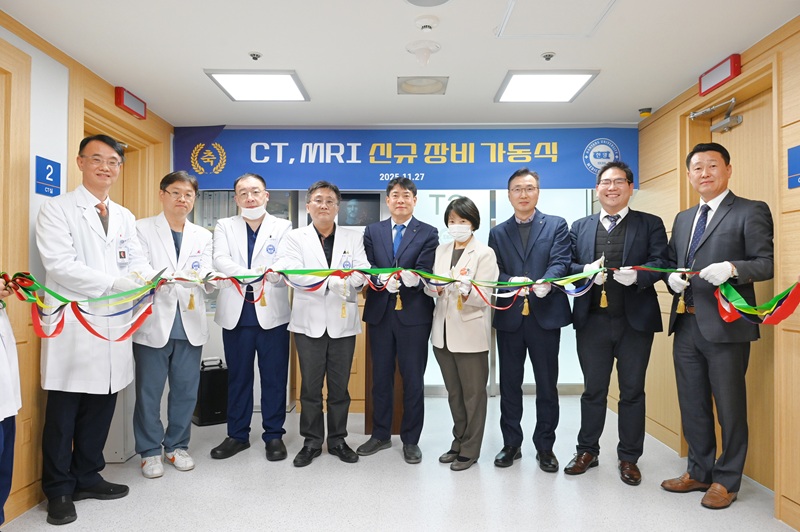
Hanyang University Hospital (President Lee Hyeongjoong) held the ‘CT and MRI New Equipment Launch Ceremony’ on November 27 in the CT room on the 3rd floor of the New Building.
By introducing CT and MRI imaging diagnostic equipment with the latest specifications in Korea, the hospital aims to greatly improve examination speed and image quality and to enhance patient safety and convenience.
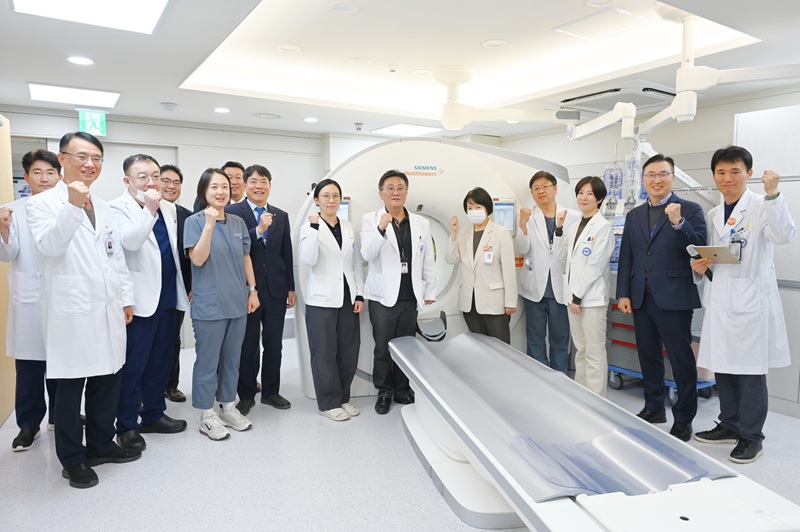
The newly introduced CT is SIEMENS' top-tier ‘SOMATOM Force (Dual Source).’ It uses a dual-source method that employs two X-Ray Tubes and Detectors simultaneously. This technology enables dual-energy and ultra-high-speed imaging, delivering excellent performance especially in cardiovascular imaging.
Scan speed, a key indicator of cardiac CT, is 0.25 seconds or less, minimizing heart motion and benefiting difficult cardiovascular imaging. In addition, its quantitative computed tomography (Q-CT) function enables osteoporosis diagnosis, and it can obtain high-quality images while lowering radiation dose, enhancing patient safety.
For MRI, GE's flagship model ‘SIGNA Premier 3.0T’ was newly introduced. It reduces the burden on patients by applying a silicone-based Air Coil that is more flexible than before, and the examination environment has been improved because the coil can be freely positioned according to the area being scanned. In addition, it produces high-resolution images with deep learning-based image reconstruction technology, and the HyperSense function shortens scan time by more than 30% compared with before. This greatly reduces the likelihood of rescans for motion-sensitive abdominal MRI.
President Lee Hyeongjoong said, “Imaging equipment plays a role like capillaries that look into the fine structures of the human body,” adding, “We expect to be able to provide safer and more accurate medical services to patients in the future.”
Lee Seunghoon, Head of the Department of Radiology, said, “Motion Correction and the use of flexible coils are factors that increase diagnostic efficiency and are also of great help to patients,” adding, “We will continue patient-centered changes such as reduced waiting times and improved examination accuracy” (End).

