
- Hanyang University–KAIST joint research team suggests the possibility of predicting treatment resistance through ‘type I interferon signaling’ in monocytes
A molecular marker has been presented that can identify, with just a blood test early in treatment, patients who do not respond to standard treatment for ‘lupus nephritis,’ a major complication of systemic lupus erythematosus (SLE), an intractable autoimmune disease. A joint research team led by Distinguished Professor of Medicine Bae Sangcheol of Hanyang University Hospital for Rheumatic Diseases and Professor Shin Euicheol of the KAIST Graduate School of Medical Science and Engineering precisely analyzed the immune cells of lupus nephritis patients over time before and after treatment, and found that in patients who do not respond to treatment, downstream ‘type I interferon’ signals persist and do not switch off even after treatment.
Dr. Kim Woojoong of KAIST (currently Assistant Professor at Chung-Ang University Hospital) and Professor Lee Hyesoon of Hanyang University Guri Hospital participated as co-first authors, and the study was published in 'Annals of the Rheumatic Diseases (IF 24.0),' the world's most authoritative international journal in the field of rheumatology [Paper title: Treatment nonresponders in lupus nephritis characteristically exhibit persistent type I interferon signalling in monocytes: a longitudinal single-cell transcriptomic analysis].
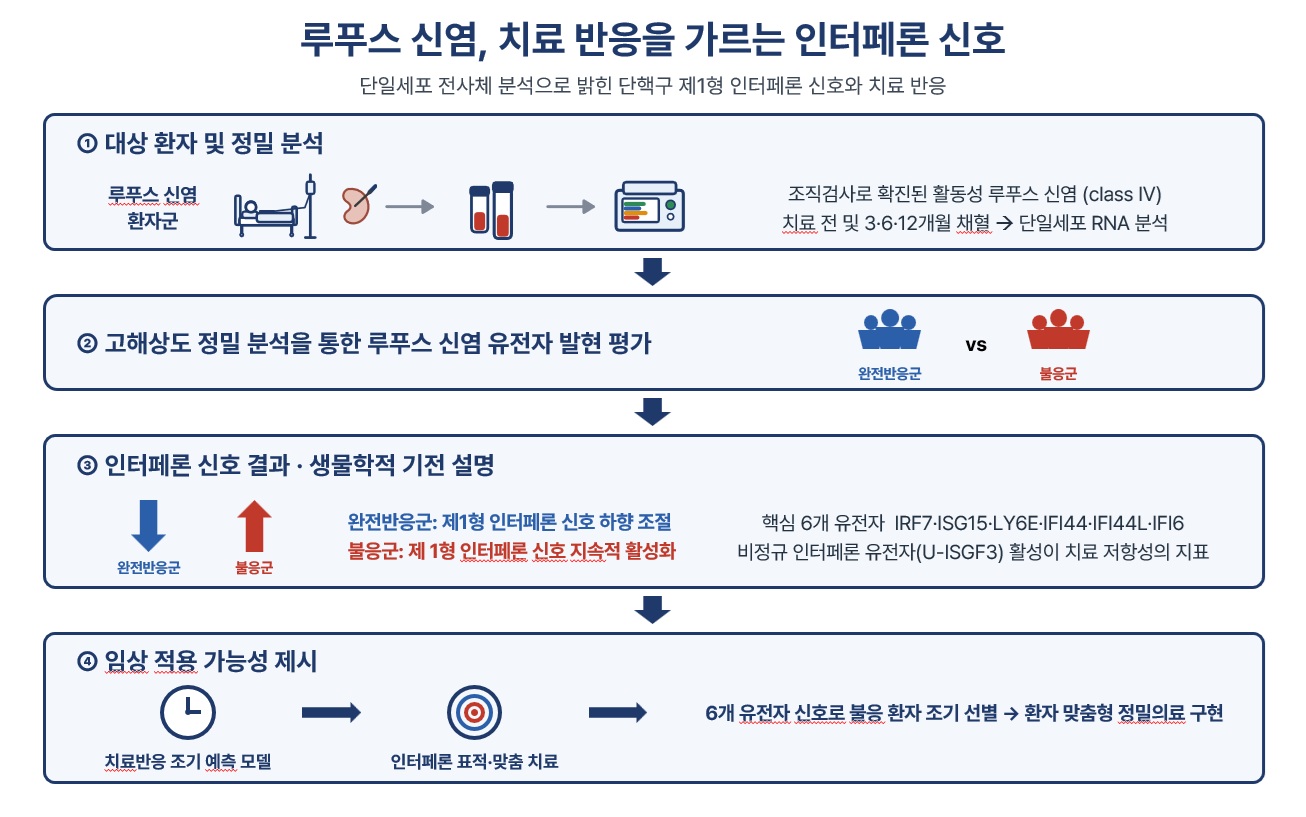
Lupus nephritis is a major complication occurring in about 35–60% of SLE patients. It is a key complication that determines patients' prognosis as it is directly linked to impaired kidney function, but many patients do not respond sufficiently to standard immunosuppressive treatment.
In particular, because proteinuria and changes in kidney function, the representative indicators for evaluating treatment efficacy, appear later than the actual immunological changes, there was the drawback that medical staff could easily continue insufficient treatment or miss the time to intensify treatment.
Using the lupus patient cohort (KUDOS) of Hanyang University Hospital for Rheumatic Diseases, the research team repeatedly collected blood immune cells from patients with biopsy-confirmed active lupus nephritis before the start of treatment and at 3, 6 and 12 months after treatment, and analyzed them using single-cell RNA sequencing.
The analysis showed that, among various immune cells, monocytes most clearly distinguished patients who responded well to treatment (hereinafter the complete response group) from those who did not respond (hereinafter the nonresponse group). In the complete response group, type I interferon signals gradually subsided after treatment, whereas in the nonresponse group the signals remained high despite treatment.
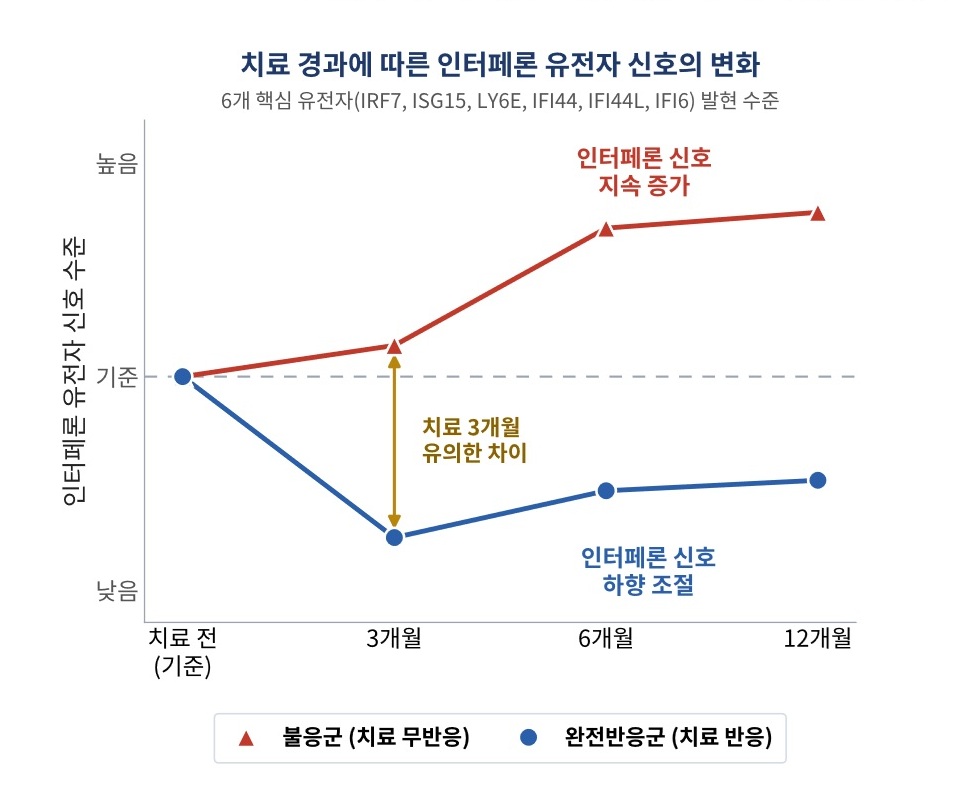
In particular, the research team confirmed that the specific yardstick for gauging the ‘type I interferon signal’ of monocytes in the blood is six interferon-stimulated genes (IRF7, ISG15, LY6E, IFI44, IFI44L, IFI6). The expression level of these six genes is a molecular marker that concisely shows the activity of type I interferon signaling; it decreased markedly within three months of treatment in the complete response group, while remaining high in the nonresponse group.
This signal was also significantly associated with proteinuria and overall lupus disease activity, and notably, the difference already appeared at three months of treatment, before existing clinical indicators (proteinuria, kidney function) showed changes.
Distinguished Professor of Medicine Bae Sangcheol said, “This study identified a key immunological mechanism associated with treatment nonresponse in lupus nephritis patients,” adding, “We expect it to serve as a foundation for precision medicine that identifies early, based on blood tests, patients expected to have a poor treatment response and establishes patient-tailored treatment strategies.”
[Reference] What is systemic lupus erythematosus [systemic lupus erythematosus (SLE)]?
It is a representative rheumatic disease that mainly occurs in young women in their 20s and 30s, and an autoimmune disease in which multiple genetic and environmental factors act in combination to cause abnormalities in the immune system. Lupus can occur in any part of the body, including the skin, joints, brain, kidneys, heart and lungs. Lupus nephritis is a disease in which autoantibodies and immune complexes accumulate in the glomeruli of the kidney and cause inflammation; along with proteinuria and hematuria, it gradually reduces kidney function and can progress to end-stage renal failure in some patients. Standard treatment uses high-dose steroids and immunosuppressants such as mycophenolate mofetil (MMF), but although many patients do not respond sufficiently, there is the limitation that it is difficult to identify nonresponding patients early. By revealing the molecular signals of immune cells important in lupus nephritis, this study is expected to make an important contribution to predicting treatment response early and developing tailored treatments.

