

|
Genetic Factors and Immune Mechanisms of Autoantibody Production Before Lupus Onset Identified
|
Immune pathways involved in the early autoimmune state of lupus discovered, suggesting the possibility of early diagnosis and treatmentHanyang University’s Professor Bae Sangcheol’s team publishes in the most authoritative journal in rheumatology (Annals of the Rheumatic Diseases)
The finding that lupus-associated genetic variants affect autoantibody formation and the immune system in the pre-onset stage of lupus was identified for the first time in the world by the research team of Professor Bae Sangcheol of the Department of Rheumatology at Hanyang University Medical Center (Soyoung Bang and Lee Hyesoon of the Department of Rheumatology, Hanyang University Guri Hospital) and the team of Professor Kim Kwangwoo of Kyung Hee University. The results were recently published in Annals of the Rheumatic Diseases (ARD, impact factor 20.3), the most authoritative journal in rheumatology. [Paper title: Genetic burden of lupus increases the risk of transition from normal to preclinical autoimmune conditions via antinuclear antibody development].
The study was conducted with support from the Hanyang University Institute for Rheumatology Research and the National Research Foundation of Korea, with Professor Soyoung Bang and researcher Cheon Sehwan (Department of Biology, Kyung Hee University) as co-first authors and Professor Bae Sangcheol and Professor Kim Kwangwoo as co-corresponding authors.
Lupus is a representative autoimmune disease in which an abnormal immune system attacks one’s own body, and in the pre-onset stage, antinuclear antibodies are present but symptoms do not appear. Although many genetic variants associated with lupus have been discovered so far, how genetic factors affect the production of antinuclear antibodies before disease onset had not been sufficiently studied.
The research team performed an extensive genome-wide association analysis of healthy individuals, autoantibody-positive individuals and lupus patients to calculate a lupus-associated polygenic risk score (PRS). The results showed that the higher a person’s lupus-associated polygenic risk score, the significantly greater the production and titer of antinuclear antibodies, and that people with above-average genetic risk scores had more than twice the risk of developing antinuclear antibodies.
The study demonstrated the effect of lupus genetic factors on autoantibody production in healthy people and identified the immune pathways involved in antinuclear antibody formation, suggesting the possibility of early diagnosis and treatment development for autoimmune diseases. It is also expected to lay the foundation for research on biomarkers predicting autoimmune diseases and to promote research into immune system abnormalities and disease mechanisms.
Director of the Hanyang University Institute for Rheumatology Research Bae Sangcheol said, "Through this study, we were able to further understand the production of antinuclear antibodies, the main autoantibodies in lupus, and the mechanisms of disease onset," adding, "The identified genetic information will contribute to predicting the onset of lupus, early diagnosis and the development of customized treatments."
[Note] What is systemic lupus erythematosus [systemic lupus erythematosus (SLE)]? A representative rheumatic disease that mainly occurs in young women in their 20s and 30s, it is an autoimmune disease in which multiple genetic and environmental factors act in combination to cause abnormalities in the immune system. Lupus can occur in any part of the body, including the skin, joints, brain, kidneys, heart and lungs, and shows a wide variety of symptoms, which is why it is also called ‘the disease with a thousand faces.’ In particular, the most important autoantibody for the onset and diagnosis of lupus is the antinuclear antibody (ANA), which is known to be produced several years before disease onset, but the exact mechanism of onset has not yet been fully identified. By shedding light on this unknown area, this study is expected to make an important contribution to the early diagnosis and prevention of lupus and the development of customized treatments. |
|
News
Hanyang University International Hospital
 The genes and immune mechanisms involved in the production of antinuclear antibodies (ANA), autoantibodies formed in the pre-onset stage of the autoimmune disease systemic lupus erythematosus (hereinafter lupus), have been identified. This study is expected to provide important clues for the early diagnosis of lupus and the development of treatments.

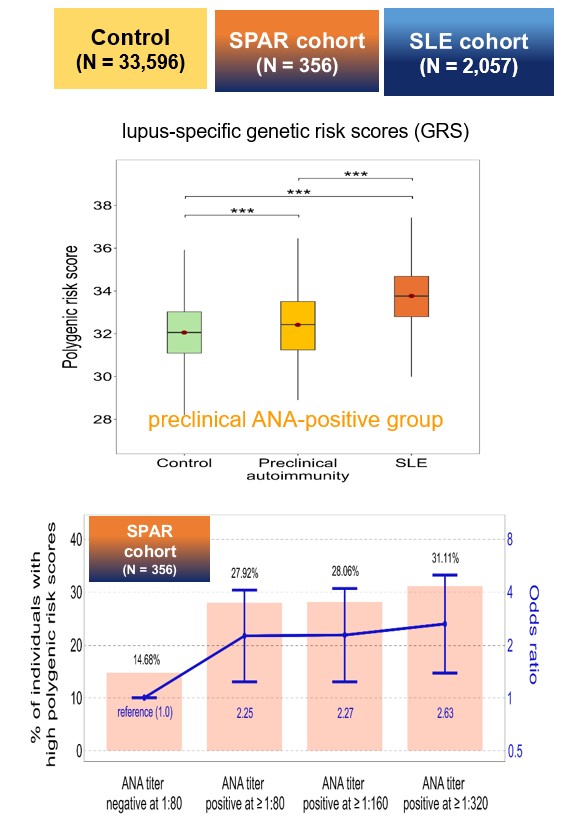 The research team also found that nine immune pathways, including T-cell and B-cell receptor signaling and cytokine-related signaling pathways, play an important role in antinuclear antibody formation in the pre-onset stage of lupus. These immune pathways play a key role in immune regulatory mechanisms and provide important clues for understanding the progression of early autoimmune diseases.