

Total posts : 1394
-
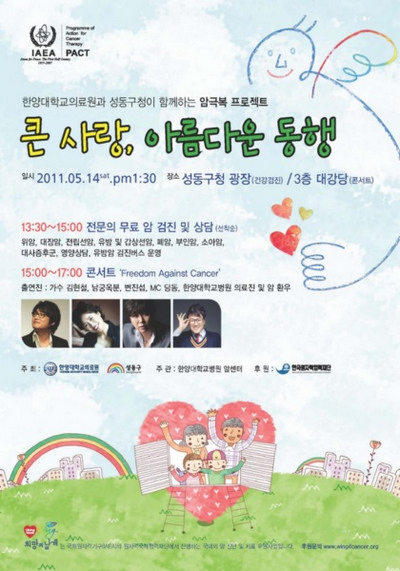
Cancer Overcoming Project with Seongdong-gu Office (Free Cancer Screening & Concert) Event
Date: Venue: Seongdong-gu Office Plaza (health screening) / Seongdong-gu Office 3rd Floor Main Auditorium (concert) 13:30–15:50 Free cancer screening by specialists and consultation (first come, first served) - Stomach cancer, colorectal cancer, prostate cancer, breast and thyroid cancer, lung cancer, gynecologic cancer, pediatric cancer, metabolic syndrome, nutrition counseling, breast cancer screening bus in operation 15:00 Concert 'Freedom Against Cancer' - Performers: singers Kim Hyunchul, Namkoong Okbun and Byun Jinsub, MC Dingdong, Hanyang University Hospital medical staff and cancer patients Hosted by: Hanyang University Medical Center, Seongdong-gu Office Organized by: Hanyang University Hospital Cancer Center Sponsored by: Korea Nuclear International Cooperation Foundation
2011-04-29
-
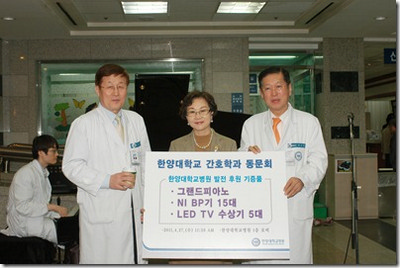
Hanyang University Nursing Alumni Association Donates Grand Piano to Hanyang University Hospital
-Donated with funds raised for the development of the alma mater and Hanyang University Medical Center The Hanyang University Department of Nursing Alumni Association, with funds raised at the recently held ‘Bazaar in Support ofthe Development of Hanyang University Hospital,’ donated one grand piano, 15 NIBP monitors and five LED TVs to Hanyang University Hospital. The donation ceremony was held on April 28 on the 1st floor of the Main Building of Hanyang University Hospital, attended by many faculty and staff including Park Sungsoo, Executive Vice President for Medical Affairs and President of Hanyang University Medical Center; Lee Choonyong, President of Hanyang University Hospital; and Oh Yeokyung, President of the Hanyang University Department of Nursing Alumni Association. In his words of thanks, Park Sungsoo, Executive Vice President for Medical Affairs and President of Hanyang University Medical Center, said, “The beautiful melodies of the grand piano donated this time will help patients recover,” adding, “I am grateful to the Hanyang University nursing alumni who always work hard for the development of Hanyang University Hospital.” In her greeting, Alumni Association President Oh Yeokyung said, “I hope the items donated by the Hanyang University Department of Nursing Alumni Association will be put to good use by all customers so that they can feel the comfort and coziness of Hanyang University Hospital.” After the donation ceremony, Lee Howon, a resident (first-year) of the Department of Urology at Hanyang University Hospital, performed Chopin’s ‘Nocturne’ and Liszt’s ‘Liebestraum,’ receiving a great response from visitors. The Hanyang University Department of Nursing Alumni Association has raised funds for the development of the alma mater and Hanyang University Medical Center since 2008, and in March 2010 it also donated a grand piano to Hanyang University Guri Hospital.
2011-04-28
-
Resident Ahn Jaebong Receives Best Poster Award at International Gastric Cancer Congress
Ahn Jaebong, a resident (R3) in the Department of General Surgery at Hanyang University Hospital, had the honor of receiving the Best Poster Award at the ‘9th International Gastric Cancer Congress’ held at the COEX InterContinental Hotel in Seoul from April 20 to 23. The award-winning paper is ‘Bone metastasis in Gastric cancer patient,’ and the supervising professor is Professor Kwon Sungjoon of the Department of General Surgery at Hanyang University Hospital. Resident Ahn said, “Bone metastasis, a form of metastasis in gastric cancer patients, is uncommon, with metastasis to the spine showing the highest frequency; elevated blood Alkalin phosphatasa is a characteristic finding, whole Body Bone Scan has high diagnostic value, and radiation therapy is for symptoms (pain),” adding, ”it is effective for relief, but patients with bone metastasis show a poor prognosis with an average survival of less than about three months, and there is still no established systemic chemotherapy, so research and development on this is needed.” The congress, held every two years, was attended by about 2,000 gastric cancer experts from 57 countries, and 760 posters were exhibited.
2011-04-28
-
Radioactive Materials from the Fukushima Nuclear Accident and Their Effects
In the aftermath of the accident at the Fukushima nuclear power plant caused by the earthquake and tsunami in Japan, radioactive iodine has been detected at 12 monitoring stations nationwide, including Seoul, along with radioactive cesium-134 and -137 in the Chuncheon and Daejeon areas and xenon in the Gangwon region, albeit in trace amounts. However, the amounts detected so far are minuscule and not at a level of health concern; nevertheless, to help you understand the situation, let us look at radiation units and recommendations related to radiation exposure. When talking about the effects of radiation on the human body, we use the unit Sv (severt: sievert). We are always exposed to radiation naturally emitted from nature and surrounding materials, such as space, rocks and soil, so the natural radiation each person receives per year amounts to about 2.4mSv (millisieverts). Generally, when the whole body receives radiation all at once, a dose of about 500mSv temporarily reduces white blood cells, 1000mSv can cause symptoms such as vomiting or diarrhea, and 7000mSv results in death. As described above, exposure to radiation above a certain level causes harm to the human body, so the Atomic Energy Act regulates radiation by setting an upper limit on exposure, which is called the dose limit. Under this law, the upper limit is 1mSv per year for the general public and 50mSv per year for radiation workers employed at nuclear power plants and similar facilities (excluding medical or natural radiation). Meanwhile, many people worry that they may develop cancer even if exposed to low doses of radiation; currently, the probability of developing fatal cancer when the whole body is exposed to 10mSv all at once is estimated at 1/10,000. The current radiation level in the Seoul and Gyeonggi regions is 108nSv/h (normal range 50~300nSv/h), indicating a normal level, so there is no need for great concern; however, should a radiation leak occur in Korea, the methods of preparation and treatment are as follows. First, you should stay far away from the place of exposure, and it is best to minimize the time of contact. It is also advisable to stay indoors or wear a gas mask and protective clothing to shield yourself from radiation. If you have been exposed to radiation, you should change your clothes and wash your skin thoroughly with soapy water. So far, the amount of radioactivity in rainwater is minuscule, so there is no need to worry much, but if radioactive rain falls, you can go out with an umbrella and raincoat or refrain from going out, and simply washing your clothes and taking a shower after returning will wash away almost all radioactive material. Among radioactive contaminants, the one requiring the most caution is radioactive iodine (I-131). This substance is used medically to treat thyroid cancer, but it is known that it can promote the development of thyroid cancer if excessive amounts enter the body. Potassium iodide (KI) is a method of preventing radioactive iodine from entering the thyroid by taking it 24 hours before directly inhaling radioactive iodine, thereby saturating the thyroid with iodine. However, unless contamination exceeds 100mSv, there is no need to take stable iodine. When exposed to radioactive iodine, the amount of iodine needed to prevent radiation exposure is 130mg, 1,733 times the recommended daily intake of 75mcg (0.075mg). The standard is set so that the total does not exceed 1 gram within 10 days. This is because excessive use can cause side effects such as skin rashes, swelling or inflammation of the salivary glands and iodine poisoning. However, the amount of radioactive iodine detected in Korea is very small and has almost no effect on health or the environment, so there is no need to overreact; moreover, iodine-131 has a relatively short half-life of eight days and is characterized by losing its radioactivity quickly. Therefore, there is no need to use potassium iodide for preventive purposes in Korea. In addition, although their iodine content is not high, eating iodine-containing sea mustard and kelp is thought to have some preventive effect, because when safe natural iodine is already in the thyroid, there is no room for radioactive iodine to enter. For reference, the iodine content of kelp is about 240ug (0.24mg) per 100g.
2011-04-22
-
Professor Ahn Donghyun of the Department of Neuropsychiatry Receives Minister of Health and Welfare Award
- Recognized for contributions to planning and establishing national mental health policy Professor Ahn Donghyun of the Department of Neuropsychiatry at Hanyang University Hospital received the Minister of Health and Welfare Award at the ‘2011 Mental Health Day Ceremony’ held at the Konkuk University New Millennium Hall on April 8. Professor Ahn Donghyun has carried out child and adolescent mental health projects and research since 1966, developed the screening tools (CPSQ, AMPQ) for the student mental health management program currently under way nationwide and had them put into use, and laid the foundation of the program by providing academic support so that the Ministry of Education, Science and Technology and the Ministry of Health and Welfare could jointly promote it. From 1988 to the present, he has devoted himself to the development of mental health as Director of the Seongdong-gu Community Mental Health Center in Seoul, and in 2007, as chairman of the name change promotion committee of the Korean Neuropsychiatric Association, he worked steadily to change the name ‘정신과 (psychiatry)’ to dispel the prejudice associated with it, leading to the promotion of legislation by lawmakers in 2011. In addition, since 2009, as Director of the Psychiatric Policy Research Institute of the Korean Neuropsychiatric Association, he has identified and proposed mental health policies through mental health policy research and forums, and he received this award in recognition of his many contributions to the planning and establishment of national mental health policy. He graduated from Seoul National University College of Medicine in 1979 and received his master’s and doctoral degrees from the same graduate school, and he serves as Vice President of the Korean Association of Child Psychotherapy, President of the Korean Association of Child Rights, and Director of the Policy Research Institute of the Korean Neuropsychiatric Association. He previously served as Chairman of the Korean Academy of Child and Adolescent Psychiatry, President of the Korean Association of Adolescent Psychiatry and President of the Korean Society of Autism.
2011-04-19
-
Department of Urology Holds Prostate Health Lecture and Free Screening
- Lectures given on the prevention and treatment of prostate diseases Hanyang University Hospital, jointly with the Korean Prostate Management Association, held a prostate health lecture and free screening at the Yangju-gun Public Health Center in Yangju-si, Gyeonggi-do, on April 14. The event was held for male local residents aged 55 and older, and about 400 people attended. At the event, Professor Lee Choonyong of the Department of Urology at Hanyang University Hospital and Professor Moon Hongsang of the Department of Urology at Hanyang University Guri Hospital gave lectures on the prevention and treatment of prostate diseases such as benign prostatic hyperplasia and prostate cancer. Free examinations were also provided to the attending residents, including free consultations, voiding dysfunction symptom score checks, PSA tests (blood draws) and ultrasound examinations to measure prostate size. As prostate diseases increase due to population aging and the Westernization of diets, this event is being organized by the Department of Urology at Hanyang University Hospital and the Korean Prostate Management Council to promote a vigorous old age through prevention and treatment based on early screening, and a ‘Prostate Health Lecture and Free Screening’ was also held on March 26 at the Yangpyeong-gun Public Health Center located in Namyangju-si, Gyeonggi-do.
2011-04-18
-
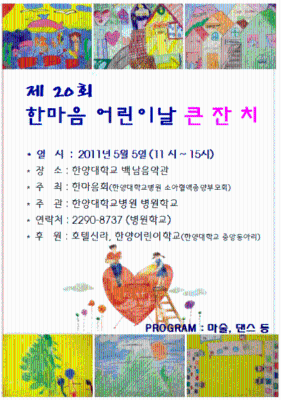
20th Hanmaeum Children's Day Festival to Celebrate Children's Day
To celebrate Children's Day on May 5, 2011, the 20th Hanmaeum Children's Day Festival will be held, hosted by the Pediatric Hematology-Oncology Parents' Association (Hanmaeum Association) of Hanyang University Hospital. Date: May 5, 2011 (11 a.m. ~ 3 p.m.) Venue: Paiknam Music Hall, Hanyang University Host: Hanmaeum Association (Pediatric Hematology-Oncology Parents' Association of Hanyang University Hospital) Organizer: Hospital School of Hanyang University Hospital Contact: 2290-8737 (Hospital School Sponsors: Hotel Shilla, Hanyang Children's School (Hanyang University central club) Program: Magic and dance performances, etc.
2011-04-15
-
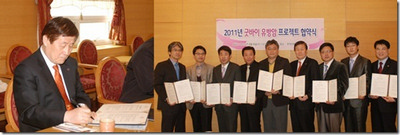
Participation in 2011 Goodbye Breast Cancer Project Agreement Ceremony
On April 6, Hanyang University Hospital and the Seongdong-gu Public Health Center held the ‘2011 Goodbye Breast Cancer Project’ agreement ceremony at the H Club of Hanyang University HIT. In addition to Hanyang University Hospital, nine hospitals in Seongdong-gu took part in the agreement ceremony, and they will provide free breast cancer screening opportunities to women excluded from the national early cancer screening program. The agreement was arranged for the health and happy lives of women in Seongdong-gu by encouraging early detection and treatment of breast cancer, which has the second-highest incidence among female cancers.
2011-04-07
-
Department of Orthopedic Surgery Holds Health Lecture on Degenerative Arthritis
2011-04-04