

Total posts : 1394
-
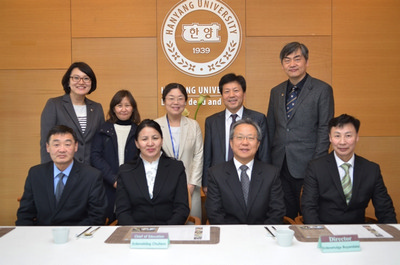
Visit by Director of Health of Darkhan City, Mongolia
Battsengel Buyannemekh, Director of Health of Darkhan City, Mongolia, Erdenebileg Chultem, Director of Education, and Erdenetulga Buyandalai, President of Darkhan First Hospital, visited Hanyang University Hospital on March 18. Hanyang University Hospital President Kwon Sungjoon said, “I hope that many medical and educational exchanges between Hanyang University Hospital and Darkhan City, Mongolia, will contribute to the development of medicine in both countries.” The delegation toured various centers, wards, Hanyang University International Hospital and other facilities and admired the advanced medical facilities; they visited Hanyang University Hospital to see Korea's health care system and facilities and to improve awareness in connection with the ‘Healthy School Capacity-Building Project’ of the Hanyang University Institute of Health and Society. Darkhan, Mongolia, is Mongolia's second-largest city, with a population of 93,000. Darkhan First Hospital was established in 1972 and is the largest national hospital in Darkhan, with 330 beds and 18 clinical departments.
2014-03-18
-
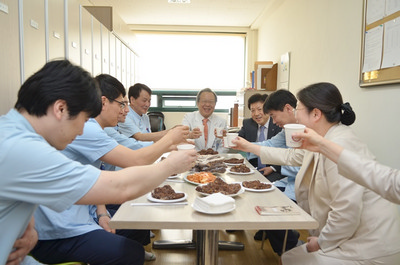
Hanyang University Hospital President Kwon Sungjoon Holds Communication Session with Employees
Hanyang University Hospital President Kwon Sungjoon held a conversation session with employees in the technical workers' office of the Department of Nursing on March 17. Gathering with the technical workers, one of the job groups that work most closely with patients, President Kwon talked with them about their wishes and difficulties and had an extensive discussion about ways to approach patients in a friendly manner.
2014-03-18
-
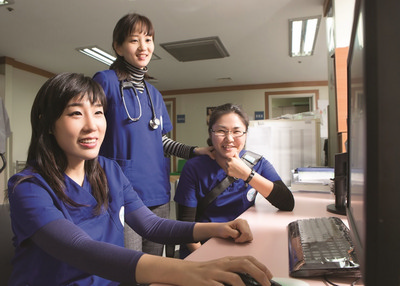
Rapid Response Team (HaRRT) Led by Professor Kwak Hyunjung Publishes SCI Paper
A paper by the team of Professor Kwak Hyunjung of the Rapid Response Team (Hanyang Rapid Response Team, HaRRT) at Hanyang University Hospital was published in the March 2014 issue of an SCI journal published by the Korean Academy of Medical Sciences. The paper is about the one-year activities of the Rapid Response Team currently operating at Hanyang University Hospital (The Extended Rapid Response System: 1-Year Experience in a University Hospital). Within one year of its launch, the Rapid Response Team at Hanyang University Hospital reduced unexpected cardiac arrests among inpatients by 31% and also lowered the mortality rate of all inpatients by 11%. In addition, two years after the team began its activities, unexpected cardiac arrests decreased even further, by 47%, and based on these successful results, the paper emphasizes the need to spread and establish rapid response systems in Korea. Professor Kwak Hyunjung said, “High-risk patients who go undetected and are missed in wards are generally known to account for about 4% of all inpatients, and 10% of them are known to suffer unexpected cardiac arrest. There are reports that even identifying and treating these patients in advance can prevent more than 30% of unexpected cardiac arrests,” adding, “The reduction in unexpected patient mortality reported in this paper shows that our hospital's system is being operated systematically and well, and it shows that even a small team of just two to four people can be effective in a hospital with up to 1,000 beds. I believe it is an important system that many hospitals in Korea should introduce for patient safety.” Rapid response teams have been set up at Hanyang University Hospital as well as Asan Medical Center in Seoul, Samsung Medical Center and Seoul National University Bundang Hospital; they are organizations that function like an in-hospital emergency room, visiting and treating patients upon a report from the primary medical staff caring for critically ill high-risk patients, and finding high-risk patients in the wards and providing emergency care. However, unlike the teams at other hospitals, the Rapid Response Team at Hanyang University Hospital is characterized by independently identifying and managing high-risk patients through test results, consultations and other means, and recommending treatment for high-risk patients before the primary medical staff request it. In other words, it is a team with a new concept that, when such a patient arises, identifies the patient upon admission or even earlier, and provides consultation and begins treatment. The Rapid Response Team at Hanyang University Hospital was launched on December 19, 2011, and is now actively operating in its third year.
2014-03-12
-
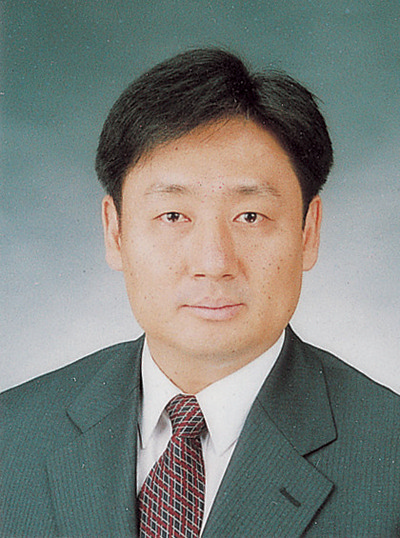
Professor Kim Jungtae of the Department of Plastic Surgery Gives Invited Lecture at Indian Society of Microsurgery Conference
Professor Kim Jungtae of the Department of Plastic Surgery at Hanyang University Hospital was invited to the conference of the Indian Society of Microsurgery held in Kolkata, India, from February 28 to March 2, 2014. At a workshop held the day before the conference, Professor Kim personally performed a surgical demonstration on an Indian patient with a head and neck tumor, and during the conference lectured on three topics, including ‘Evolution of Microsurgical Reconstruction’. With this invitation, Professor Kim became the first Korean to give an official invited lecture in India, a country with a long history of microsurgery, was selected as the speaker for the society's Godina Ornation and even received a medal, and pledged many future exchanges with Indian microsurgery specialists. Meanwhile, Professor Kim Jungtae graduated from Hanyang University College of Medicine and received master's and doctoral degrees from the same graduate school. Professor Kim is actively engaged as Editor-in-Chief of Archives of Plastic Surgery, Director of Publications of the Korean Society of Plastic and Reconstructive Surgeons, a director of the Korean Society for Aesthetic Plastic Surgery, Director of Scientific Affairs of the Korean Society for Microsurgery and Director of Publications of the Korean Society for Surgery of the Hand.
2014-03-11
-
Health Lecture on Hypertension and Stroke Successfully Held
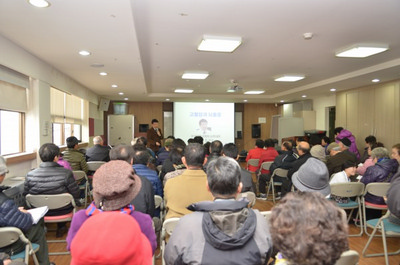
Hanyang University Hospital successfully held a free health lecture for local residents on the theme ‘Prevention and management of hypertension and stroke’ at the Gwangjin-gu Public Health Center on March 4. In the lecture, Shin Jinho, Professor of Cardiology at Hanyang University Hospital, said, “Hypertension is such a common disease that 30% of Korean adults aged 30 or older have it, and as many as half of elderly people aged 60 or older have it,” adding, “Because hypertension is easily controlled just by taking medication, strokes can be prevented very effectively, but even while taking hypertension medication, other risk factors such as cholesterol, smoking, diabetes and obesity must be well managed to maximize the preventive effect.” In addition, on April 10, the hospital will hold a free health lecture on ‘Prevention and management of cardiovascular and cerebrovascular diseases’ for residents of Seongdong-gu at Wangsimni Catholic Church.
2014-03-05
-
Professor Kim Yongjoo of the Department of Pediatrics & Adolescent Finds Parasite Over 3 m Long in 13-Year-Old Boy
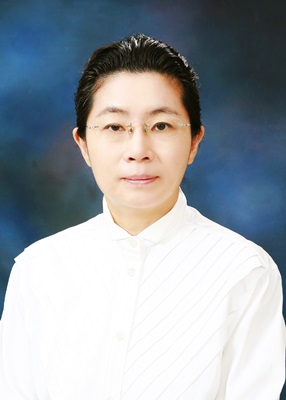
Parasite over 3 m long emerges from the body of a 13-year-old boy -Discovered by Professor Kim Yongjoo of the Department of Pediatrics Adolescent at Hanyang University Hospital -Such a case in a child is very rare among domestic reports - Stool tests should be included as a mandatory item at health screening institutions in Korea Professor Kim Yongjoo of the Department of Pediatrics Adolescent at Hanyang University Hospital recently found a parasite more than 3 m 50 cm long from the anus of a 13-year-old boy. The parasite broke off midway as it came out, so it is expected to actually be longer, and such cases in children have rarely been reported in Korea. The boy, who often enjoyed eating raw fish with his parents, visited the pediatric outpatient clinic of Hanyang University Hospital after a long parasite came out of his anus and his fatigue worsened. In a stool test at the outpatient clinic, ‘Diphyllobothrium latum eggs’ were observed in his stool. Professor Kim Yongjoo said, “To observe the parasite in the boy’s body with the naked eye, we had him take a medication and waited until the parasite came out of his anus, then expelled one parasite from the body and obtained gross observation findings. We carefully pulled it out; it was about 3 m 50 cm long, and it broke off midway after being expelled to that extent,” adding, “The boy often enjoyed raw fish, and there is a high probability that he was infected with Diphyllobothrium latum from raw fish.” Diphyllobothrium latum is a type of tapeworm distributed in temperate regions and areas close to the Arctic, and Russia and Scandinavia are known as endemic areas. The main definitive host is humans; the eggs of Diphyllobothrium latum living in the human intestine fall into the toilet with human feces and travel through the sewage system into water. The eggs released into the environment develop into coracidia (50µm) in water, are ingested by water fleas, the first intermediate host, and then by brackish-water fish, the second intermediate host. The second intermediate hosts are mainly perch on the Asian continent and trout and salmon in Japan, and in Korea they are, in order, salmon, mullet, sea bass and trout. The scolex of Diphyllobothrium latum has no suckers or hooks but has elongated grooves, with which it attaches mainly to the small intestine in the gastrointestinal tract and lives as a parasite. Professor Kim also said, “The general public needs to know that deworming drugs purchased over the counter without a prescription cannot remove tapeworm parasites such as Diphyllobothrium latum, so taking general deworming medicine regularly does not eliminate such parasites. In particular, people who enjoy raw live fish or fish dishes that have not been frozen and sterilized need to be especially careful. If health screening institutions in Korea included stool tests as a mandatory item, various parasitic diseases could be diagnosed.”
2014-02-26
-
Hanyang University Medical Center Holds ‘2014 First-Half Retirement Ceremony’
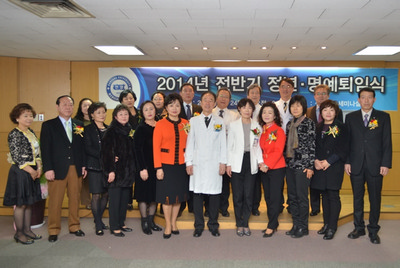
Hanyang University Medical Center held the ‘2014 First-Half Retirement Ceremony’ in the seminar room on the sixth floor of the New Building on February 24. The event was attended by many key officials and faculty and staff members, including Park Choongki, Executive Vice President for Medical Affairs and President of Hanyang University Medical Center, and Hanyang University Hospital President Kwon Sungjoon, who gave a round of applause in gratitude and congratulations. At the event, Park Choongki, Executive Vice President for Medical Affairs and President of Hanyang University Medical Center, said, “You have spent most of your lives at Hanyang, and since we have been together for so long, I imagine this farewell must be filled with regret and sadness,” adding, “Following in your footsteps as you leave today, we will strive to make Hanyang University Medical Center, which you developed with passion and love, a source of pride for you.” He also said, “I hope that this retirement today becomes another starting line in your lives,” and, although it will not be a life at Hanyang, I hope you will wonderfully cultivate the things you have wanted to enjoy all this time.”Meanwhile, at the event, all 14 retirees received merit awards in recognition of the contributions they made while serving at Hanyang University Medical Center.
2014-02-25
-
Professor Bak Koanghum of the Department of Neurosurgery Elected President of the Korean Spinal Tumor Study Group
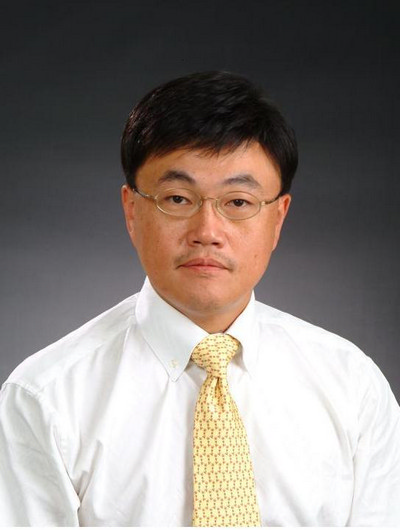
Professor Bak Koanghum of the Department of Neurosurgery at Hanyang University Hospital was elected President of the Korean Spinal Tumor Study Group at the ‘9th Korean Spinal Tumor Study Group Scientific Meeting,’ held on February 15 at the Lecture Hall Building of Hanyang University College of Medicine. The Korean Spinal Tumor Study Group was founded in 2010 as a subspecialty study group under the Korean Cancer Association. Its members, who belong to fields such as neurosurgery, orthopedic surgery, radiation oncology and hematology-oncology and treat primary or metastatic cancers of the spine, are active in the group, and it is scheduled to be registered as a study group under the Korean Spinal Neurosurgery Society in 2014. Professor Bak Koanghum graduated from Hanyang University College of Medicine in 1987 and received his master’s and doctoral degrees from the same graduate school. He is active in the Korean Neurosurgical Society, the Korean Spinal Neurosurgery Society, the American Association of Neurological Surgeons (AANS, CNS), the North American Spine Society (NASS) and the Cervical Spine Research Society (CSRS), and serves as a director of the Korean Society of Medical Appraisal, a standing director of the Korean Spinal Neurosurgery Society, a director of the Minimally Invasive Spine Surgery Study Group and general affairs director of the Spinal Tumor Study Group.
2014-02-19
-
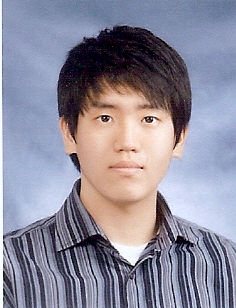
Neurosurgery Resident Baek Seungchul (R2) Wins Namchul Academic Award from the Korean Society of Cerebrovascular Surgeons
Baek Seungchul (R2), a resident in the Department of Neurosurgery at Hanyang University Hospital, won the Namchul Academic Award at the ‘27th Annual Meeting of the Korean Society of Cerebrovascular Surgeons,’ held over two days on February 14–15 at the Westin Chosun Hotel in Busan. Resident Baek presented a poster titled ‘A Predictive and Risk Factors of Terson’s syndrome: A retrospective analysis in 256 patients with subarachnoid hemorrhage.’ The poster presented a retrospective analysis of predictive and risk factors for Terson’s syndrome in 256 patients with subarachnoid hemorrhage, and in recognition of the excellence of its content, it was selected as the best poster and received the award.
2014-02-19